



Benjamin Rijnsburger
In the sixth book of the Iliad, Helen speaks to Hector about the war that she, in a sense, caused. She ends with a strange sentence: “Zeus planted a killing doom within us both, so even for generations still unborn we will live in song.”

Notice what she says. Not: we suffer, and afterwards someone will sing about it. She says: we suffer so that there will be song. The suffering seems to exist for the sake of the story.
That sentence is my way into the question: what is the function of storytelling and art for human existence, in the face of death, suffering and war?
My primary text is Nietzsche’s The Birth of Tragedy, sections one to four. It gives one of the most radical answers in the history of philosophy: art is what makes existence bearable at all. I read it alongside Homer, the poet Nietzsche calls the “naïve artist”, and I use five secondary sources: Martine Prange, Lessing, Benjamin, Sontag and Butler.
My thesis is this. Nietzsche is right that Homeric art is born from suffering, not from naive harmony. But his image of art as an Apollonian veil that hides suffering does not fit what Homer actually does. Homer does not hide the cry; he frames it. And that difference matters. An art that only transfigures suffering into beauty risks turning lament into enjoyment, which is what Benjamin calls the aestheticization of war. I will argue that the deepest function of storytelling in the face of war is neither consolation nor fame alone, but making loss grievable.
Apollonian versus Dionysian Truth

Nietzsche wrote The Birth of Tragedy, as he says in the foreword, “amidst the horrors and sublimities of the war” of 1870. And already there he makes his central claim: art is not “a merry diversion”, but “the highest task and the properly metaphysical activity of this life”.
Why would art be that serious? In section three Nietzsche tells an old Greek story. King Midas captures Silenus, the companion of Dionysus, and asks him what is best for man. Silenus laughs and answers: “What is best of all is for ever beyond your reach: not to be born, not to be, to be nothing. The second best for you, however, is soon to die.”
This is the Dionysian truth. Beneath individual life lies what Nietzsche calls a Primordial Unity, “Eternally Suffering and Self-Contradictory”. Seen from there, the individual life has no meaning.
And then the key sentence: “The Greek knew and felt the terrors and horrors of existence: to be able to live at all, he had to interpose the shining dream-birth of the Olympian world between himself and them.”
That is Nietzsche’s answer to our question. Art, and the Homeric gods are for him the first great artwork, is a protective screen. It is Apollonian: Apollo is the god of dream, of form, of beautiful appearance, the schöner Schein.
Two things are crucial here.
First, this is not naive. Nietzsche attacks the Romantic idea that Homer expresses an original harmony between man and nature. Homeric naïveté, he writes, “can be comprehended only as the complete triumph of the Apollonian illusion”, a triumph over “a terrible depth of world-contemplation and a most keen susceptibility to suffering”.
Second, the result is a reversal of Silenus. “Thus do the gods justify the life of man, in that they themselves live it the only satisfactory Theodicy!” For the Homeric hero the worst thing is now “to die early”, and the second worst “some day to die at all”. And then the sentence that will guide the rest of my presentation: in Homer, “the very lamentation becomes its song of praise.”
Suffering and Art
So for Nietzsche, the function of art in the face of death is transfiguration. The lament for short-lived Achilles does not turn us away from life; it makes us want it. I think that is partly true. But look at Nietzsche’s vocabulary. The horrors are “veiled and withdrawn from sight”. The Olympian world is placed between us and suffering. And in section four, to dream with joy we must have “completely forgotten the day and its terrible obtrusiveness”. On this model, art works by forgetting.

Martine Prange, in “Why Do We Need Myth?”, takes Helen’s sentence as the point where Homer and Nietzsche part ways. She pairs it with a line from the Odyssey, where King Alcinous tells the weeping Odysseus that the gods spin “threads of death through the lives of mortal men, and all to make a song for those to come”.
Her formulation is sharp: Nietzsche says we tell stories because we suffer; Homer says we suffer in order to tell stories. For Nietzsche, story protects us from reality. For Homer, according to Prange, story is how we “gain existence at all”. War threatens “a fameless and anonymous death”, and song answers it. So Odysseus can say at the Phaeacian court: “I am Odysseus, son of Laertes, known to the world for every kind of craft, my fame has reached the skies.”
Prange also notices that Helen plays two roles. At her loom she remembers; in the Odyssey she mixes a drug into the wine, “magic to make us all forget our pains”. Helen, Prange concludes, “is the symbol of memory and oblivion alike”. Art must “bring oblivion and comfort against people’s present misery, but, even more important, to memorize, to keep the past alive”. In those terms, Nietzsche’s Apollo stands on the side of oblivion, and Prange puts Homer on the side of memory.
Art as Veil or as Frame?
I think this improves on Nietzsche. Homeric song is not just a soothing illusion; it preserves persons. But Prange’s answer raises a question she does not ask: whose existence does the song secure, and at what price?
To answer that, I go back to the Iliad itself, to book eighteen, and read it through Lessing.
Lessing’s Laocoon is a polemic against Winckelmann, who had claimed that Greek art shows “a noble simplicity and quiet grandeur”: a great soul that does not cry out in pain. Lessing answers with Homer. “Homer’s wounded heroes not infrequently fall with a cry to the ground.” And he concludes: “Judged by their deeds they are creatures of a higher order; in their feelings they are genuine human beings.”

Lessing’s reason for the statue’s silence matters for my argument. It is not Stoic dignity: “Screams must be reduced to sighs, not because screams would betray weakness, but because they would deform the countenance to a repulsive degree.” Sculpture shows one frozen moment and stands under the law of beauty. Poetry unfolds in time and may let the cry be heard. “Who blames the poet, then?” Lessing asks. So the veil belongs to the statue, not to the poem. In a sense, Nietzsche reads Homer the way Winckelmann read the statue.
That is exactly what we see in book eighteen. When Achilles hears that Patroclus is dead, “a black cloud of grief” shrouds him. He pours ash over his head, throws himself in the dust and tears his hair, and Antilochus holds his hands, afraid he will cut his own throat. Nothing here is veiled. The greatest hero of the poem lies in the dirt and groans.
Then comes the line I consider the heart of my argument. Achilles decides to return to battle, knowing it means his own death, and says: “But for now, let me win fame and glory too, and make many a deep-breasted Trojan woman moan without cease, wiping the tears from her tender cheeks with both her hands.”
Here we see the structure of epic fame, kleos, with brutal honesty. The glory of one man is made from the tears of others. Prange is right that song gives existence, but the Iliad shows that this existence is unequally distributed: Achilles’ immortality is woven from the grief of nameless women.
What does Homer do with this? He does not hide it. Hephaestus, forging Achilles’ new shield, says to Thetis: “I wish that I could save him from sad death, when the fateful time arrives, as easily as I can grant him splendid armour, splendid enough to make many a man marvel who gazes on it.” Art cannot save anyone from death. It can only make people look.
And what do they see on the shield? A city at peace, with weddings and a trial about the blood-price of a dead man. A city at war, where Fate is “dragging a corpse through the chaos by its feet”, her cloak “red with human blood”. And in the middle of the harvest, a boy sings the song of Linos, which is a lament.
Affirming Life or Aestheticizing Suffering and Death?
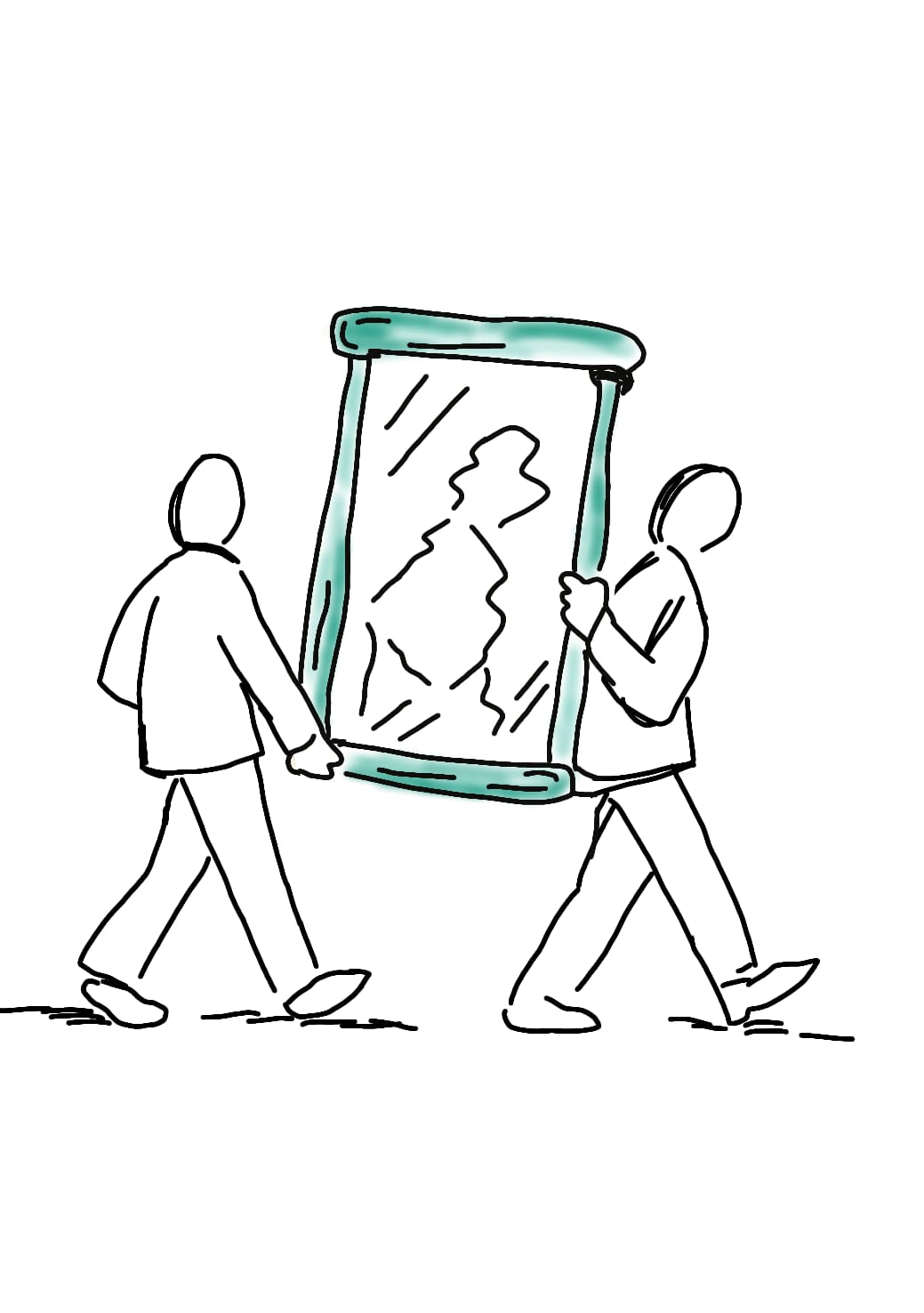
So, the most beautiful artwork in the Iliad does not veil suffering. It holds war and peace, slaughter and lament, in one form. In Nietzsche’s terms: the Apollonian is there, but as a frame, not as a veil. A veil hides what lies behind it. A frame shows something, and in showing it, decides how it can be seen.
Why does this distinction matter? Because Nietzsche’s model has a dark side, and Nietzsche saw it. In a note from 1875, quoted by Prange, he writes: “The gods enjoy the misery of people, when they hear about it in songs. The Greeks knew this; they knew that only by means of art can misery be turned into joy.” And in “Homer’s Contest”, from the same period as The Birth of Tragedy, he asks: “Why did the whole Greek world rejoice over the pictures of battle in the Iliad?” and fears “that we would shudder if we ever did understand them in a Greek way.” In the same essay he admits that Homer’s world only looks milder “through an artistic deception”, and that without “Homer’s guiding and protecting hand” we would look “only into night and horror”.
If art turns misery into joy, then the standpoint of art becomes the standpoint of the Olympian gods, who watch human suffering as a spectacle.
This is exactly where Walter Benjamin’s warning comes in. At the end of “The Work of Art in the Age of Mechanical Reproduction” he quotes the Futurist Manifesto, “War is beautiful”, and comments: “Mankind, which in Homer’s time was an object of contemplation for the Olympian gods, now is one for itself. Its self-alienation has reached such a degree that it can experience its own destruction as an aesthetic pleasure of the first order.” Fiat ars, pereat mundus: let there be art, though the world perish.
Benjamin names Homer’s gods, and I think we should take that seriously. “The very lamentation becomes its song of praise” can go two ways. It can mean affirming life in spite of death, as in Homer. But it can also mean aestheticizing death itself, so that the beauty of the image replaces the reality of the loss.
Susan Sontag shows how thin that line is. In Regarding the Pain of Others she notes that “the same antiwar photograph may be read as showing pathos, or heroism”. The image does not carry its meaning with it; the frame decides. That is why she insists: “No ‘we’ should be taken for granted when the subject is looking at other people’s pain.”
Applied to Homer: who is the “we” that lives in song? Achilles, Hector and Helen, yes. But the Trojan women whose tears make Achilles’ glory have no names.
When is Beauty in the Face of Suffering Legitimate?
So, what is the function of storytelling in the face of death and war? I propose an answer between Nietzsche and Prange, with the help of Judith Butler.
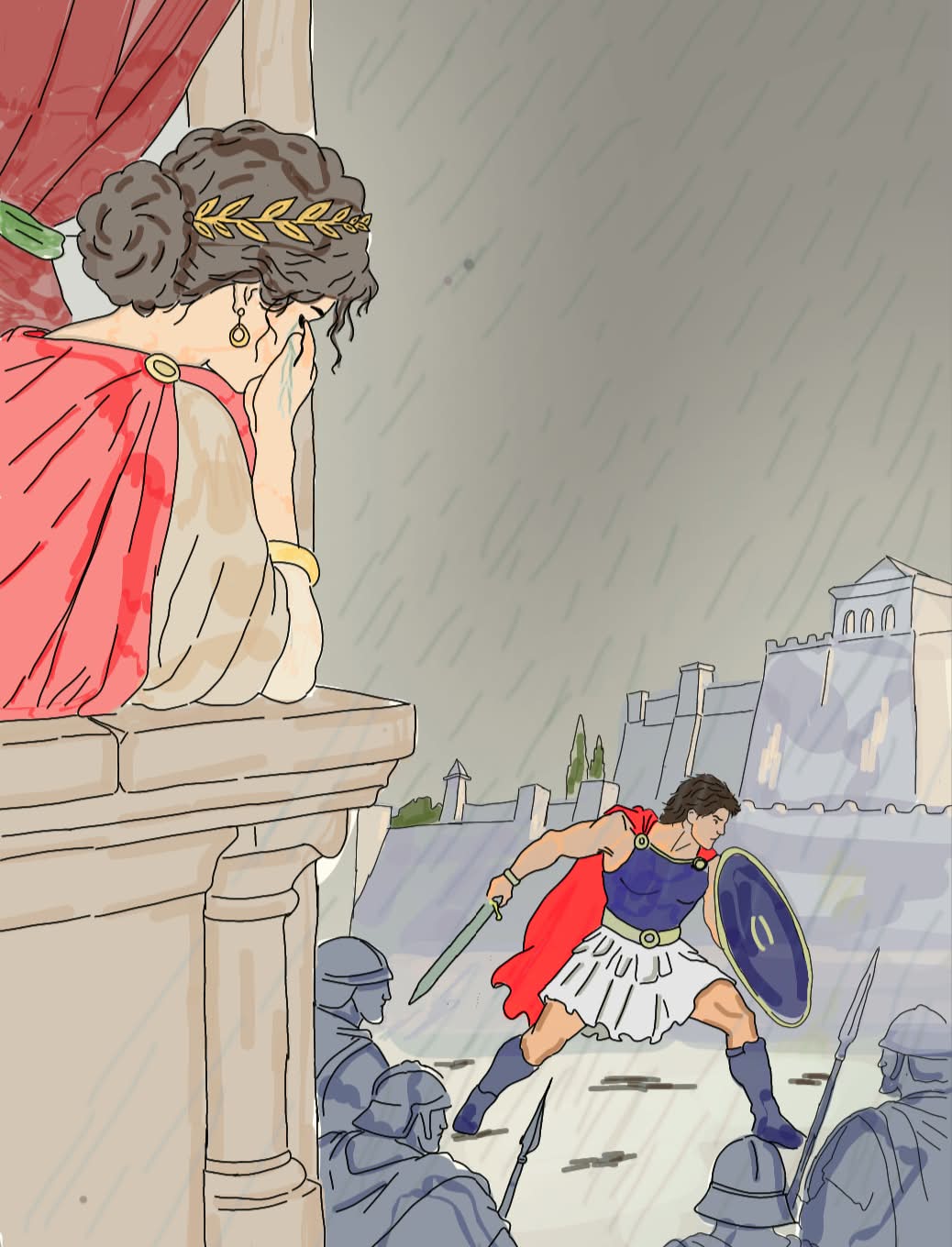
In Frames of War, Butler argues that frames determine which lives we can see as lives at all. Her central concept is grievability: “Only under conditions in which the loss would matter does the value of the life appear.” Without it, there is “a life that will never have been lived, sustained by no regard, no testimony, and ungrieved when lost.”
I think this captures the deepest point of Helen’s sentence. To “live in song” is not only to be famous, as Prange says, and not only to be transfigured into beautiful appearance, as Nietzsche says. It is to be grievable: to be a life whose loss matters, because it has been witnessed and lamented. Homer’s greatness is that his frame is wider than his heroes. It includes Thetis mourning a son who is still alive, the dead man whose blood-price is argued on the shield, the boy singing the Linos lament.
From this I draw a criterion. Beauty in the face of suffering is legitimate when it keeps the loss visible as loss: when the song of praise remains a lament. It becomes dangerous when it turns loss into enjoyment: when the lament disappears into the song. Nietzsche’s formula must therefore be read in both directions. In Homer, the lament becomes a song of praise. But a song of praise that is no longer a lament is the beginning of what Benjamin feared.
Let me end at Hephaestus’ forge. Art cannot save Achilles from death; it can only make us marvel as we look. Nietzsche teaches us that we need beautiful appearance to be able to live at all. Homer teaches us that this appearance should not close our eyes, but open them. And Sontag, Butler and Benjamin force us to ask: whom do we see when we look?
Helen said: “we will live in song.” I would add: the song is only true if it also remembers those whose tears it was made from.
Noten
[1] Bron in het Publieke Domein van een fresco uit circa het jaar 50 van Apollo op een fresco in Rome afkomstig van The Yorck Project (2002) 10.000 Meisterwerke der Malerei (DVD-ROM), distributed by DIRECTMEDIA Publishing GmbH. ISBN: 3936122202.
[2] Bron in het Publieke Domein van een standbeeld: Meer dan levensgrote Dionysos met satyr, panter, en druiven op een wijnstok (Romeinde kopie 2e eeuw) — Palazzo Altemps, Rome. Collection National Roman Museum of the Altemps Palace. Source/Photographer Marie-Lan Nguyen (September 2006). Afbeelding op 24 oktober 2026 opgevraagd van https://commons.wikimedia.org/wiki/File:Dionysos_satyr_Altemps_Inv8606.jpg


